Obviously, in order to continue my Duplo work in the absence of any money, it is necessary to take the initiative to rescue papers, stationery, and miscellaneous concepts (either physically embodied or mentally suggested) from those fonts of inspiration - trade waste bins. Plucky sirs and ma'ams - and yes, these respectful titles DESERVEDLY apply to any foragers of consumerist overspill - routinely pick through the containers (and I've met many such personages) bravely rescuing, recycling or reselling goods destined for landfill. Motives may differ, but the overall arc of intent tends towards the ethically brilliant, the admirably thrifty and the heroically inventive. My own motives are fused with occult experiments in dismantling acts of modern day witchcraft (particularly prevalent with charity shop volunteers) as described previously. It seems strange, but witchcraft - or some modern variant of divination - is often the only way to account for some of the desecrations I've seen: objects still loaded with use-value placed alongside other such objects, interspersed with needless and gratuitous muck.
Today, somebody decided to call the police... Some low-life "pillar-of-the-community" scum-sucking cradle of dysentery, no doubt. Evidently their vision had been offended. Or perhaps they peevishly saw their own cauldron of consumer witchcraft being picked apart, and their petty spells diffused into nothingness. Ha ha! So much the better. Next, on the scene arrives two policemen - in two separate cars - duty bound to interrogate me, whereupon I dispensed all personal details ranging from the exact duration of my earthly existence so far, to the direction of the 'grain' on my scrotum. The scene dragged on for an unseemly long time, ruining the bin-diving schedule. I do not yet know what the outcome of this encounter will be, but if further criminations follow, I can only up the ante and state that my responsibilities as arbitrator between the thought-world and reality (that is, the essence of Duplo and its doodle skirmishes, now often sculptural too) outweigh any obligations to be shepherded by manifest evil. The ethical aspects of interrupting the stream of wastage must also surely demolish any such statutory laws, absurd by-laws, and sickening, insulting travesties of interpretations of the Public Order Act.
Again, I can only decry the good-for-nothing, moronic, haughty yokel who, in his/her tiny brain thought that calling the police was an acceptable act when presented with such blatant (yet tragically unregistered) heroism. I'm employed by both Duplo and the Nod Gods to scour the lands for the conceptual nourishment of this doodlecraft continuation. My rewards are mental. At the same time, I observe, counteract and deconstruct obvious acts of witchcraft - the fruits of my labours here will be of benefit to future generations (hopefully).
After informing the policemen that I possess a document from the management of the particular squandering effusionists in question giving me express permission to continue my work, I now realise that this document relates to another shop, and also addresses me by one of several pseudonyms I use, and is thus legally valueless. I have mislaid it anyway. "We'll be in contact," they said. I wonder what on earth they can do? The location in question is on a public right-of-way. The wastage is some of the worst I've ever seen. I hereby call upon the Nod Gods themselves and other thought-forces within the arc of common-sense to demolish this preposterous apparatus of bovine wrath that has leaked its toxic dribble upon me today.
Saturday, 26 April 2014

Thursday, 6 March 2014
Duplo and the Third Dimension - Part Two
This posting forms the belated sequel to 'Duplo and the Third Dimension - Part One', posted in November 2011. It feels that only a matter of days have passed since penning that blog post (perceptions of time are all relative, and it's nothing to be embarrassed about). This blog charts the trajectory of doodlecraft emissions that gradually progressed through dimensionalities. Duplo began as a mental oubliette to stow over-energetic doodleforms born of catharsis, its perimeters gradually vanishing until the doodleforms escaped... as we shall see.
For doodleforms to increase their dimensionality, a willing collusion is required on the part of the instigator; much as in hypnosis - the subject must be cooperative. Nod Gods were freed from one-dimensional quarantine by gifts of cartoonish vehicular apparatus, providing manoeuvrability within the 2D world of exercise books and pocketable papers. The challenge and creative problem-solving involved in the nourishing of doodleforms appealed to other classmates, as I described previously. Duplo was a means to control doodleforms, but its spoiling-for-an-uprising, cod-fascist high-and-mightiness provided a good excuse to sketch elaborate battlefields of melodrama. The progression to the next dimension - the 3D world - was occasioned by the use of computers in creating virtual worlds. It was a natural transition, given that Nod Gods themselves partly derived from the culture of computer gaming. Nod Gods, being spheroidal, were easily dolloped out in 3D rendering software. In those pre-internet days, such software was gleaned from magazine cover CDs - Visual Reality 1.5 was seized upon, as its tagline promised something along the lines of an escape to a new world. The Nod Gods' presence in the third dimension immediately heralded the tenancy of a 3D Duplo Officer, and numerous 3D Duplo/anti-Duplo machinations soon followed.
A short prehistory may be in order. Arriving in the secondary school's First Year in 1993, myself and a friend decided to become librarians. Library duties occupied our breaktimes - tasks included shelving books to the Dewey specifications, aligning chairs, and helping other people find things. The appeal of librarianship lay partly in the avoidance of the dull tarmac playground. The library seemed an ideal place to experimentalise doodlecraft. Librarianship quickly lost its allure however when obnoxious older pupils began messing up shelves on purpose. These hostilities became tiresome. Furthermore, older jobsworth librarians would scupper any doodling activity by agitating us out from some perceived idleness - I was even physically barred from merely reading the library's monthly copy of 'CD-ROM Magazine'.
In the 1990s, it was distinctly unfashionable to be knowledgable in computers. Secondary school offered BBC Micros, RM Nimbuses, and various IBM PCs running Windows 3.1. Then, all of a sudden, Windows 95 machines swept all these away. A big "fuck off" was gestured towards the library, and stewardship of the computer room beckoned. Many of us still owned Commodore Amigas at home, and those of us who did were compelled to push our Amigas to perform like a Windows 95 PC - in my case this simply entailed displaying images imported from PCs and making pretend. 3D images were rendered on the PC and converted to Amiga IFF image format to distribute on 'Duplo disks'.
 My ambitions to become a computer game developer have long since been dashed against the rocks on the shores of bewilderment, but throughout the 1990s I pursued these dreams in various attempts to create virtual simulations of life. Whereas real-life actions tend to have consequences, these simulations - centred around school life - provided an arena for enactments not possible in real life. The foremost of these self-built 'games' was Mount Viewpoint on the Amiga (examined previously the first part of 'Duplo and the Third Dimension'): set in primary school and its surrounding suburbs, all from within the Freescape 3D engine. Freescape did not allow sphere shapes, alas. Doodles and Duplo did not feature in this game owing to such representational limitations, but it facilitated both a mode of thinking in three dimensional terms, and presented a promised land: a 'middle-ground' between reality and imagination.
Mount Viewpoint had no ending or level completion strategy, but it was playable. A PC successor to Mount Viewpoint was never completed in any playable state - it was called TBSHS: The Game, and was set at the titular acronymous secondary school. I took measurements around school and noted down tile patterns and textures. Location sounds were also recorded on dictaphone and sampled as wonky in-game noises. By the year 2000, it had dawned on me that I was no longer at school. Everybody I had known had stopped talking to me because they wanted girlfriends and newfangled poise, etc. I digress...
 To return to the matter of 3D... TBSHS: The Game was notable for actual real-life 2D digitisations of teachers placed within a highly accurate reconstruction of the sprawling school environment. This represented the pinnacle of a graphical flourish I habitually employed in 3D rendering software: placing 'real-world' 2D cut-outs in 3D worlds.
It cannot be stressed enough how mentally significant this was. Maybe younger generations take such things for granted, but back in the mid-1990s, it was mindblowing. Picture this: a sketch is drawn in an exercise book. The sketch is then scanned and digitally cut-out. PC-based 3D software is then used to build a scene for the sketch, it is then introduced and rotated to face the virtual camera. The scene is subsequently rendered as an image, and lastly, downsampled and converted to an Amiga graphics format for slide-shows on Duplo disks, viewed on cathode ray televisions... Televisions RF switchable between Amiga input or TV aerial. The very same televisions we watched Noel's House Party, X-Files and Gamesmaster upon.
Despite the fact that these 3D images were only stills, they fired the imagination in a peculiar way. And successive dimensions would soon fall within doodlecraft's demesne...

 A custom Quake level for the PC was designed with Duplo Officers and Nod Gods, but like TBSHS: The Game, it does not seem to have survived data reshuffles over the years.

 |
| A dot matrix Nod God - one of the earliest computerised renderings, c. 1994 |
 |
| The Duplo Officer in glorious 3D |
In the 1990s, it was distinctly unfashionable to be knowledgable in computers. Secondary school offered BBC Micros, RM Nimbuses, and various IBM PCs running Windows 3.1. Then, all of a sudden, Windows 95 machines swept all these away. A big "fuck off" was gestured towards the library, and stewardship of the computer room beckoned. Many of us still owned Commodore Amigas at home, and those of us who did were compelled to push our Amigas to perform like a Windows 95 PC - in my case this simply entailed displaying images imported from PCs and making pretend. 3D images were rendered on the PC and converted to Amiga IFF image format to distribute on 'Duplo disks'.
Mount Viewpoint had no ending or level completion strategy, but it was playable. A PC successor to Mount Viewpoint was never completed in any playable state - it was called TBSHS: The Game, and was set at the titular acronymous secondary school. I took measurements around school and noted down tile patterns and textures. Location sounds were also recorded on dictaphone and sampled as wonky in-game noises. By the year 2000, it had dawned on me that I was no longer at school. Everybody I had known had stopped talking to me because they wanted girlfriends and newfangled poise, etc. I digress...
 |
| TBSHS : The Game - An uncompleted PC sequel to Mount Viewpoint |
It cannot be stressed enough how mentally significant this was. Maybe younger generations take such things for granted, but back in the mid-1990s, it was mindblowing. Picture this: a sketch is drawn in an exercise book. The sketch is then scanned and digitally cut-out. PC-based 3D software is then used to build a scene for the sketch, it is then introduced and rotated to face the virtual camera. The scene is subsequently rendered as an image, and lastly, downsampled and converted to an Amiga graphics format for slide-shows on Duplo disks, viewed on cathode ray televisions... Televisions RF switchable between Amiga input or TV aerial. The very same televisions we watched Noel's House Party, X-Files and Gamesmaster upon.
 |
| A sketched Duplo Officer placed within a virtual 3D environment |
Saturday, 21 December 2013
Extracts from a 2013 Diary, Touching on Jung's Synchronicity, Bin Diving and Witchcraft
The brilliant history of Duplo will be resumed at some point. It has been discouraging to find that nobastard is interested in this nodgodsmackingly amazing history of the evolution of doodleform. Disgracefully, this corrupt society in which we currently live champions only the shittiest of windbags. To this day I have not even been allowed any form of employment. Thankfully I am able to continue my Duplo doodleform contemplations simply by looking through the bins of local businesses and charity shops. Nowadays, the constant interplay between doodleforms and anti-doodleforms has been elevated to terahertz dyads of abstract colour combinations that inspire fully internalised doodleform dramas. In contrast to previous postings, I now assert that general society does not deserve to see new Duplo imagery, hence this internalised approach. This is an arrogant assertion, yes, but the self-styled upholders of this scum-capitalist-system - local busybodies and crypto-fascist numpties - are likewise arrogant shitheads, and I'm only mirroring what is presented to me.
I'll attempt to chronicle the second part of the story of 'Duplo and Third Dimension' at some point soon. In the meantime, some observations and diary notes may be disclosed.
In around 1996, during the third form at school, I remember having my workbook of Duplo doodleforms confiscated and thrown in a skip at the instigation of the head of year, Mrs. Anderson. The argument was that 'General Workbooks' were school property, and should not be filled with doodles. It was also stated that the doodlings were of an unhinged nature, yet they merely mirrored the unhinged nature of the environment: ignoramuses of brutality were allowed to spread their mental phthisis unchallenged. My general workbook of Duplo imagery did not deserve such gratuitous treatment. If it was considered wasteful to fill the workbook with Duplo drawings, surely they had destroyed their own argument by throwing it in the skip?!
I was told that I'd face detention if I were to reclaim my general workshop from the skip. With a headful of resentment I reclaimed it nonetheless, and nobody noticed. If my doodleforms were considered skipworthy, I reasoned that skips (and all other receptacles of dispossession) must contain some intrinsic value at least on a par with the righteous counteraction of too-virulent ideas through doodlecraft, as seen in my workbook. In adult life, adrift in this despicable economy based on lies, enslavement and fear, I know only too well the mechanics of rescuing discards from trade waste containers. Within these vessels of destruction can be seen the great firewall of capitalism propelling consumers to endlessly buy new things unnecessarily. Dare somebody stand poised to re-use or repair a second-hand commodity, some furrowed brow descends; idiotic bovines bark "get out the bins, tramp!" - and weird traps are set to prevent such salvaging. Most unexpectedly, charity shop employees almost always behave like witches covens. Does all this mark the presence of an economic hive mind?
With no employment forthcoming, I have developed my own currency away from this contemptible economy, based mainly on colour, form, concept and unforeseen conjunctions thereof.
Over the past decade, I have embarked on systematic and tidy scroungings of almost every business's waste containers. This has not only sustained me, but most importantly, it has also provided fuel for doodleform. (Duplo originally evolved at school through ideas being bounced around a group of people, but in the absence of these people, bins are now the interaction du jour - their contents read in tasseomancy postures [albeit the bins have a 'refresh rate' of at least 24 hours so can hardly be thought of as animate a substitute as old Duploistas]).
Some of these bin divings necessarily take place at exposed spots - visible to passersby. I remain undeterred, having nothing to lose. The task seems too important to worry about any distant tuts. Occasionally, there are deliberate despoliations, set either by the businesses themselves, occupants of adjoining premises or other busybodies. These hostile acts of desecration carry a territorial, political aspect. It is even more surprising to find that charity shops also practice this. Their employees are often some of the most uncharitable, territorial and finicky in the locality.
At one particularly ridiculous so-called charity shop, in early October 2009, a 'trap' greeted any prospective bin-analyser: the bin contents were systematically drizzled in an unknown syrup every afternoon. This was presumably to spoil the discards in the economic sense. Whilst it is sad to behold the mass extinguishing of objects' use-values, my interest in pen-conjuration led me to view these practices as modern day witchcraft. This theory actually came to pass when, days after witnessing a toy skeleton placed atop a Stephen Gately CD amid the syrupy cauldron, the young pop singer died suddenly and prematurely. (That hideous newspaper, the Daily Mail, later featured a piece by a lady called Jan Moir who made unwarranted snide remarks about the manner of the pop star's passing.) This coincidence was highly supportive of Jungian synchronicity, and I distributed anonymous manifestos strongly condemning the sly practise of intentionally ruining symbolically charged items.
I worded the manifestos in a manner so as to avoid being identified, but still failed to resist the addition of subtle pen-conjurations, a la Duplo. Nothing palpable ever became of these emissions.
The location, known to me as one of many fruitful zones since the early 2000s, became an "area of interest" - to be studied closely. Earlier this year, once again, some systematic despoiling occurred at the same shop, and this time I had hoped to prove the existence of synchronicity by listing all "activated" object combinations and their possible outcomes. The complexity of the task was enormous, but a number of blank notebooks duly presented themselves almost by way of challenging me. Little did I know, by focussing on capturing examples of synchronicity a sort of feedback takes place. Here are some extracts from my diary charting the lead-up to the feedback's punchline:
Friday 26th July: One bin heavily drenched in a sort of orange coloured 'soup' (courtesy of the adjacent Fish and Chip shop? They certainly were obnoxious).
Saturday 27th July: All bins covered in orange 'soup'. All male employees of Fish and Chip shop seen giggling nearby. Some orange liquid also splattered on a nearby car. A lady walking by said "did you do that?" I said, "No. It was already here." The repeat incident suggests the start of a systematic despoliation.
On Monday 29th July, I arrived earlier to see if the culprit could be caught red/orange handed. As the shop was still open, I asked if any of the volunteers knew about the orange liquid, and they seemed concerned about it, as it produced an unpleasant odour in the heat. I suggested it most likely originated from some impish employee of the nearby fish and chip shop who dislikes alternative economies. Obviously, I had to couch my objectives in the blandest possible terms ("I'm collecting typefaces as a hobby"). Me and the two female workers all unanimously condemned the behaviour, but a slight note of cynicism was felt from them. A few minutes later, after the shop had closed, I returned to the bins to discover two shades of blue paint had been squirted over the surface materials! Who did it? Was it carried out under the guise of 'charity'?
As I took samples of the wet blue paint and investigated what objects were affected, I noticed boxes of books at my feet. It was beginning to rain, so I had a peek to see what titles would soon meet their watery end. The books were on psychological and esoteric topics, and on closer inspection, Jungian synchronicity! This seemed a strange punchline to a cosmic joke.
Does synchronicity resist close study? This certainly suggests so... which is frustrating. There were also many texts on meditation, apparently inviting deep contemplation upon this development.
On Saturday 3rd August, again, the shop's symbolically loaded discards were contaminated with shaving foam and hand cream. Both contaminants were white in colour. All the ladies from the shop were present when I arrived (I stood slightly out of their line of vision). They all seemed in buoyant spirits - evidentially energised by this malevolent act of "cleansing". Of course, this shaving foam and hand cream combo is an attempt to appear "whiter than white" on one hand, but the actual action of the fluid was one of shameful destruction - in physical, mental and spiritual terms. Evidently in denial. It is difficult to decide whether to reverse the effects by new interventions, or merely observe them and anticipate the outcomes.
On Friday 11th October, during a bin dive, a man with a slight accent accosted me. Very speedily and boldly, he began rummaging too. He was not afraid to lean into the bins to pluck items from inside. It becomes difficult for me to take notes on the object-combinations in these circumstances. The next day (12th), as soon as I'd started tentatively plucking at the contents with my telescopic implements, he appeared once again in his car. He told me he needed toys for the "little one" and any metals which he jokingly said paid "for beer money". He was friendly and certainly very bold in his actions: he ended up turning the entire bin on its side! Maybe he was trying to outdo me in terms of unconcern for being seen; in the wake of such wastefulness, this is certainly no bad thing! He remarked that he visited the same location at night. I hope he finds great and useful things.
Today, as Christmas approaches, I have not made any more discoveries or connections regarding the synchronicity. I have observed an absurd flow of landfill-destined goods, from which I've plucked materials and stationery to keep Duplo conjurations coming for many years to come. The rather pompous female "volunteers" were gathered outside the back door today, viciously condemning the systematic rescuings from their (gratuitous) discards. Full of Christmas cheer. The more work I do in this direction, the more it uncovers the comedic aspects of this sick, unjust travesty of a 'society'!
I'll attempt to chronicle the second part of the story of 'Duplo and Third Dimension' at some point soon. In the meantime, some observations and diary notes may be disclosed.
In around 1996, during the third form at school, I remember having my workbook of Duplo doodleforms confiscated and thrown in a skip at the instigation of the head of year, Mrs. Anderson. The argument was that 'General Workbooks' were school property, and should not be filled with doodles. It was also stated that the doodlings were of an unhinged nature, yet they merely mirrored the unhinged nature of the environment: ignoramuses of brutality were allowed to spread their mental phthisis unchallenged. My general workbook of Duplo imagery did not deserve such gratuitous treatment. If it was considered wasteful to fill the workbook with Duplo drawings, surely they had destroyed their own argument by throwing it in the skip?!
I was told that I'd face detention if I were to reclaim my general workshop from the skip. With a headful of resentment I reclaimed it nonetheless, and nobody noticed. If my doodleforms were considered skipworthy, I reasoned that skips (and all other receptacles of dispossession) must contain some intrinsic value at least on a par with the righteous counteraction of too-virulent ideas through doodlecraft, as seen in my workbook. In adult life, adrift in this despicable economy based on lies, enslavement and fear, I know only too well the mechanics of rescuing discards from trade waste containers. Within these vessels of destruction can be seen the great firewall of capitalism propelling consumers to endlessly buy new things unnecessarily. Dare somebody stand poised to re-use or repair a second-hand commodity, some furrowed brow descends; idiotic bovines bark "get out the bins, tramp!" - and weird traps are set to prevent such salvaging. Most unexpectedly, charity shop employees almost always behave like witches covens. Does all this mark the presence of an economic hive mind?
With no employment forthcoming, I have developed my own currency away from this contemptible economy, based mainly on colour, form, concept and unforeseen conjunctions thereof.
Over the past decade, I have embarked on systematic and tidy scroungings of almost every business's waste containers. This has not only sustained me, but most importantly, it has also provided fuel for doodleform. (Duplo originally evolved at school through ideas being bounced around a group of people, but in the absence of these people, bins are now the interaction du jour - their contents read in tasseomancy postures [albeit the bins have a 'refresh rate' of at least 24 hours so can hardly be thought of as animate a substitute as old Duploistas]).
Some of these bin divings necessarily take place at exposed spots - visible to passersby. I remain undeterred, having nothing to lose. The task seems too important to worry about any distant tuts. Occasionally, there are deliberate despoliations, set either by the businesses themselves, occupants of adjoining premises or other busybodies. These hostile acts of desecration carry a territorial, political aspect. It is even more surprising to find that charity shops also practice this. Their employees are often some of the most uncharitable, territorial and finicky in the locality.
At one particularly ridiculous so-called charity shop, in early October 2009, a 'trap' greeted any prospective bin-analyser: the bin contents were systematically drizzled in an unknown syrup every afternoon. This was presumably to spoil the discards in the economic sense. Whilst it is sad to behold the mass extinguishing of objects' use-values, my interest in pen-conjuration led me to view these practices as modern day witchcraft. This theory actually came to pass when, days after witnessing a toy skeleton placed atop a Stephen Gately CD amid the syrupy cauldron, the young pop singer died suddenly and prematurely. (That hideous newspaper, the Daily Mail, later featured a piece by a lady called Jan Moir who made unwarranted snide remarks about the manner of the pop star's passing.) This coincidence was highly supportive of Jungian synchronicity, and I distributed anonymous manifestos strongly condemning the sly practise of intentionally ruining symbolically charged items.
I worded the manifestos in a manner so as to avoid being identified, but still failed to resist the addition of subtle pen-conjurations, a la Duplo. Nothing palpable ever became of these emissions.
The location, known to me as one of many fruitful zones since the early 2000s, became an "area of interest" - to be studied closely. Earlier this year, once again, some systematic despoiling occurred at the same shop, and this time I had hoped to prove the existence of synchronicity by listing all "activated" object combinations and their possible outcomes. The complexity of the task was enormous, but a number of blank notebooks duly presented themselves almost by way of challenging me. Little did I know, by focussing on capturing examples of synchronicity a sort of feedback takes place. Here are some extracts from my diary charting the lead-up to the feedback's punchline:
Friday 26th July: One bin heavily drenched in a sort of orange coloured 'soup' (courtesy of the adjacent Fish and Chip shop? They certainly were obnoxious).
Saturday 27th July: All bins covered in orange 'soup'. All male employees of Fish and Chip shop seen giggling nearby. Some orange liquid also splattered on a nearby car. A lady walking by said "did you do that?" I said, "No. It was already here." The repeat incident suggests the start of a systematic despoliation.
On Monday 29th July, I arrived earlier to see if the culprit could be caught red/orange handed. As the shop was still open, I asked if any of the volunteers knew about the orange liquid, and they seemed concerned about it, as it produced an unpleasant odour in the heat. I suggested it most likely originated from some impish employee of the nearby fish and chip shop who dislikes alternative economies. Obviously, I had to couch my objectives in the blandest possible terms ("I'm collecting typefaces as a hobby"). Me and the two female workers all unanimously condemned the behaviour, but a slight note of cynicism was felt from them. A few minutes later, after the shop had closed, I returned to the bins to discover two shades of blue paint had been squirted over the surface materials! Who did it? Was it carried out under the guise of 'charity'?
As I took samples of the wet blue paint and investigated what objects were affected, I noticed boxes of books at my feet. It was beginning to rain, so I had a peek to see what titles would soon meet their watery end. The books were on psychological and esoteric topics, and on closer inspection, Jungian synchronicity! This seemed a strange punchline to a cosmic joke.
Does synchronicity resist close study? This certainly suggests so... which is frustrating. There were also many texts on meditation, apparently inviting deep contemplation upon this development.
On Saturday 3rd August, again, the shop's symbolically loaded discards were contaminated with shaving foam and hand cream. Both contaminants were white in colour. All the ladies from the shop were present when I arrived (I stood slightly out of their line of vision). They all seemed in buoyant spirits - evidentially energised by this malevolent act of "cleansing". Of course, this shaving foam and hand cream combo is an attempt to appear "whiter than white" on one hand, but the actual action of the fluid was one of shameful destruction - in physical, mental and spiritual terms. Evidently in denial. It is difficult to decide whether to reverse the effects by new interventions, or merely observe them and anticipate the outcomes.
On Friday 11th October, during a bin dive, a man with a slight accent accosted me. Very speedily and boldly, he began rummaging too. He was not afraid to lean into the bins to pluck items from inside. It becomes difficult for me to take notes on the object-combinations in these circumstances. The next day (12th), as soon as I'd started tentatively plucking at the contents with my telescopic implements, he appeared once again in his car. He told me he needed toys for the "little one" and any metals which he jokingly said paid "for beer money". He was friendly and certainly very bold in his actions: he ended up turning the entire bin on its side! Maybe he was trying to outdo me in terms of unconcern for being seen; in the wake of such wastefulness, this is certainly no bad thing! He remarked that he visited the same location at night. I hope he finds great and useful things.
Today, as Christmas approaches, I have not made any more discoveries or connections regarding the synchronicity. I have observed an absurd flow of landfill-destined goods, from which I've plucked materials and stationery to keep Duplo conjurations coming for many years to come. The rather pompous female "volunteers" were gathered outside the back door today, viciously condemning the systematic rescuings from their (gratuitous) discards. Full of Christmas cheer. The more work I do in this direction, the more it uncovers the comedic aspects of this sick, unjust travesty of a 'society'!
Sunday, 30 December 2012
Towards a Renaissance in Word Processing
Every time documentation of the second part of 'Duplo and the Third Dimension' is attempted, progress is scuppered. It is as if an anti-Duplo, anti-Nod God force is at work here. Earlier this year there was an altercation in the town library - I had reached the allocated free time limit on their internet computers, obliterating all my unsaved writings. It is particularly outrageous, as I had been using the computer for word processing, *not* internet access (which is evidently curated by the town library as a sort of tantalising peepshow). In these internet-obsessed times, it seems there do not exist public computer terminals for bog-standard word processing - so invaluable for gathering one's thoughts. (I do have an old computer for this purpose, but no electricity at present. Inverters feeding off vats of battery acid yielded inconsistent results.) Attention must be drawn to the principle of the matter - why is 'word processing' no longer appreciated as a distinct art? Disgracefully, society has not deemed it appropriate to furnish me with employment, so I must necessarily blag limited computer access or sod about with bits of dustbin-scavenged inks, papers, scissors and glue. The physical cut-and-paste method has its drawbacks: the results might easily be mistaken for the jottings of an indecisive maniac, when they are in fact refined strands of doodlecraft scholarship.
Whenever 'word processing' is mentioned to people, they often stare blankly. The concept is not fully understood in this day and age. If only the detritus of the 21st century could be cleansed from their minds, then 'word processing' would stand out as a glorious aid to humanity, and certainly not a thing to be taken for granted.
Whenever 'word processing' is mentioned to people, they often stare blankly. The concept is not fully understood in this day and age. If only the detritus of the 21st century could be cleansed from their minds, then 'word processing' would stand out as a glorious aid to humanity, and certainly not a thing to be taken for granted.
Sunday, 27 November 2011
Duplo and the Third Dimension - Part One
Returning to the Annals of Duplo narrative… Here I will begin descanting on the multimedia phase of Duplo. This period is of especial interest, as it demonstrates the prescience of Duplo's futurological contemplations.
Nowadays, nearly all computer games employ a 3D graphics engine to some extent. It was quite a different story in the early to mid-1990s when 2D was the dimension du jour. Of course, some notable games bucked the trend, but hardware capability was an issue (particularly on the Commodore Amiga) and there was also the sense that 3D negated the artistry and characterfulness achievable with 2D. There persisted a doomed faith in 2D graphic engines - spurred on by the prospect of full motion video incorporation - exampled by the production of short-lived platforms such as the Philips CD-i, the Amiga CD32 and the misnamed 3DO, all of which were geared toward 2D.
Around 1993, I had programmed a game utilising the Freescape 3D engine (via 3D Construction Kit and Amos) called Mount Viewpoint. Mount Viewpoint was a clumsy game set in a commune where each inhabitant had mislaid a possession, and the protagonist would brave various tightropes, planks over acid-filled swimming pools and murderous hovering cuboids to reunite people with their objects. On completion of the game, the player could climb the stairway to Mount Viewpoint itself, overlooking the entire commune, where the community could literally be 'looked down upon' by the player from a great height in an open-ended sense of lordship.
Mount Viewpoint was unrelated to Duplo - being more of a side-project. It was difficult to inject character into 3D games at this time (making Duplo's character-craft very resistant to a 3D makeover - Freescape did not have textured 3D objects), however, the superior sense of spacial realism and 'infinite control' within interactive 3D environments was very much in evidence, especially when one was virtually stood atop Mount Viewpoint! The superiority of 3D was sensed, along with its seemingly endless possibilities. Sadly, this original Mount Viewpoint is now lost (but possibly still owned on floppy by somebody). Although, there was a larger 'sequel' of a very different nature (now archived)...

 Around 1994, there was a widely-felt desire to replicate the school environment in the form of a computer simulation. An ultra-realistic simulation of 'life' was suggested, indistinguishable from real life, where outrageous gestures, surreal actions and sundry vengeances could be enacted freely. With the help of my peers, I set about trying to recreate known locations using this same Freescape engine. The large sprawling secondary school and its teacherhood was still quite unfamiliar and complex, so instead I created a representation of the old primary school. Due to laziness with titling, this new game retained the Mount Viewpoint tag despite this being a completely different and somewhat controversial new project.
 This new Mount Viewpoint sequel was offered to an Amiga public domain distributor by post, but the disk was returned with a letter explaining that the game was too slow (pushing the Amiga to its limits!) and "very sick" in theme. In the text-heavy game, all characters were based on real life characters (except the nameless balaclava-clad assassin).

 The plot sees a fascist headmistress targeted by a hitman, hired by the teachers' union, after it is disclosed that the headmistress had shot an infant dead in an appallingly misjudged act of corporal punishment (which the player witnesses whilst hiding under the headmistress' office desk). Lacking any true moral framework, the player autistically ambles around with the vague intention of killing both the headmistress, and (nihilistically) random teachers too… With a laser gun.
 Familiar locations were painstakingly virtualised. Many banal flourishes were featured, such as the player's reluctance to "step on the nice floral arrangements", and an incident where the player is compelled to stalk a dog walker whose dog fouls a footpath - carrying the turd and sneakily posting it back into the owner's letterbox for bonus points. The protagonist would also suffer tiredness and would fall asleep in sheds and dustbins after exertions. Touches such as these added some realism. Despite this reality-borrowed tedium, it was noted by Duploista Peter R- that all Mount Viewpoint's characters resemble "jelly babies" (lack of character was a real bugbear with the Amiga's 3D capabilities).
Copies of this game were circulated amongst a limited circle, and it was dreamt that we could somehow use a telephone line to all "meet up" virtually inside the 3D world (this dream prefigured the rise of multi-player internet gaming).
 Following this game, 'Duplo disks' were developed and distributed. These contained a gallery of several Duplo images and scans, prior to a menu offering a selection of choice playable commercial game demos ripped from magazine coverdisks. The images on these disks featured stills from Mount Viewpoint, with scanned 2D drawings overlaid onto the scenes.
In 1995, the use of the PC allowed for further graphical editing and subsequent conversion to the Amiga IFF image format using CrossDOS. Because there were more Amiga owners than PC owners, the Amiga 'Duplo disks' were still distributed as late as 1997, by this time featuring Duplo music as well as enhanced galleries and animations. At school, Duploistas would submit drawings to be scanned, and placed in virtual worlds before inauguration into Duplo disk galleries. On the walk to school every morning, new multimedia disk ideas were discussed.
As a footnote, it is unfortunate that when 'Mount Viewpoint - The Richard Whittington J.M.I. School Hullabaloo' was finally completed in 1999, its release was understated in the extreme, hence everybody had moved on technologically, mentally and physically. I was rather ashamed to have programmed it in the first place, deeply weird and disconcerting as it was (to illustrate further: in 1999 the Columbine killers in the U.S. were [mistakenly] reported to have designed Doom levels based on their Columbine school). To be continued...

Nowadays, nearly all computer games employ a 3D graphics engine to some extent. It was quite a different story in the early to mid-1990s when 2D was the dimension du jour. Of course, some notable games bucked the trend, but hardware capability was an issue (particularly on the Commodore Amiga) and there was also the sense that 3D negated the artistry and characterfulness achievable with 2D. There persisted a doomed faith in 2D graphic engines - spurred on by the prospect of full motion video incorporation - exampled by the production of short-lived platforms such as the Philips CD-i, the Amiga CD32 and the misnamed 3DO, all of which were geared toward 2D.
Around 1993, I had programmed a game utilising the Freescape 3D engine (via 3D Construction Kit and Amos) called Mount Viewpoint. Mount Viewpoint was a clumsy game set in a commune where each inhabitant had mislaid a possession, and the protagonist would brave various tightropes, planks over acid-filled swimming pools and murderous hovering cuboids to reunite people with their objects. On completion of the game, the player could climb the stairway to Mount Viewpoint itself, overlooking the entire commune, where the community could literally be 'looked down upon' by the player from a great height in an open-ended sense of lordship.
Mount Viewpoint was unrelated to Duplo - being more of a side-project. It was difficult to inject character into 3D games at this time (making Duplo's character-craft very resistant to a 3D makeover - Freescape did not have textured 3D objects), however, the superior sense of spacial realism and 'infinite control' within interactive 3D environments was very much in evidence, especially when one was virtually stood atop Mount Viewpoint! The superiority of 3D was sensed, along with its seemingly endless possibilities. Sadly, this original Mount Viewpoint is now lost (but possibly still owned on floppy by somebody). Although, there was a larger 'sequel' of a very different nature (now archived)...

 Around 1994, there was a widely-felt desire to replicate the school environment in the form of a computer simulation. An ultra-realistic simulation of 'life' was suggested, indistinguishable from real life, where outrageous gestures, surreal actions and sundry vengeances could be enacted freely. With the help of my peers, I set about trying to recreate known locations using this same Freescape engine. The large sprawling secondary school and its teacherhood was still quite unfamiliar and complex, so instead I created a representation of the old primary school. Due to laziness with titling, this new game retained the Mount Viewpoint tag despite this being a completely different and somewhat controversial new project.
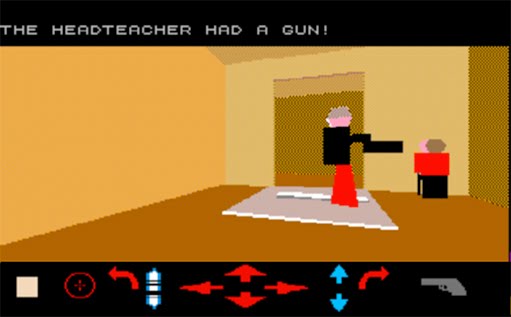 This new Mount Viewpoint sequel was offered to an Amiga public domain distributor by post, but the disk was returned with a letter explaining that the game was too slow (pushing the Amiga to its limits!) and "very sick" in theme. In the text-heavy game, all characters were based on real life characters (except the nameless balaclava-clad assassin).
 The plot sees a fascist headmistress targeted by a hitman, hired by the teachers' union, after it is disclosed that the headmistress had shot an infant dead in an appallingly misjudged act of corporal punishment (which the player witnesses whilst hiding under the headmistress' office desk). Lacking any true moral framework, the player autistically ambles around with the vague intention of killing both the headmistress, and (nihilistically) random teachers too… With a laser gun.
 Familiar locations were painstakingly virtualised. Many banal flourishes were featured, such as the player's reluctance to "step on the nice floral arrangements", and an incident where the player is compelled to stalk a dog walker whose dog fouls a footpath - carrying the turd and sneakily posting it back into the owner's letterbox for bonus points. The protagonist would also suffer tiredness and would fall asleep in sheds and dustbins after exertions. Touches such as these added some realism. Despite this reality-borrowed tedium, it was noted by Duploista Peter R- that all Mount Viewpoint's characters resemble "jelly babies" (lack of character was a real bugbear with the Amiga's 3D capabilities).
Copies of this game were circulated amongst a limited circle, and it was dreamt that we could somehow use a telephone line to all "meet up" virtually inside the 3D world (this dream prefigured the rise of multi-player internet gaming).
 Following this game, 'Duplo disks' were developed and distributed. These contained a gallery of several Duplo images and scans, prior to a menu offering a selection of choice playable commercial game demos ripped from magazine coverdisks. The images on these disks featured stills from Mount Viewpoint, with scanned 2D drawings overlaid onto the scenes.
In 1995, the use of the PC allowed for further graphical editing and subsequent conversion to the Amiga IFF image format using CrossDOS. Because there were more Amiga owners than PC owners, the Amiga 'Duplo disks' were still distributed as late as 1997, by this time featuring Duplo music as well as enhanced galleries and animations. At school, Duploistas would submit drawings to be scanned, and placed in virtual worlds before inauguration into Duplo disk galleries. On the walk to school every morning, new multimedia disk ideas were discussed.
As a footnote, it is unfortunate that when 'Mount Viewpoint - The Richard Whittington J.M.I. School Hullabaloo' was finally completed in 1999, its release was understated in the extreme, hence everybody had moved on technologically, mentally and physically. I was rather ashamed to have programmed it in the first place, deeply weird and disconcerting as it was (to illustrate further: in 1999 the Columbine killers in the U.S. were [mistakenly] reported to have designed Doom levels based on their Columbine school). To be continued...

Monday, 31 October 2011
'Sexual Offences' of the Nod Gods
 A couple of tuppenny ha'penny printing shops have flatly refused to print a run of pamphlets detailing doodlecraft. Both have insinuated that they find the content to be libellous, defamatory and of worrying taste. Yes, it is true that local hindrances to doodlecraft mechanics are identified, and several case studies in 'muse-deflation attempts' are plainly expounded in no uncertain terms. But surely the job of the printing shop is to print what is presented - 27 pages of hard-won wisdom - not to critique its content?! Denying custom, they thus stand in the way of information dissemination.
In the manuscript, one particularly misconstruable diatribe highlights the usage of the law to smear the efforts of any effusionist. A controversial argument: flypostering or depositing codices in public places for persons to discover may fall under the criminal act of "sending a menacing communication". Inversely, the act of simply glancing in (or out) windows, or into any other portals of realtime information, carries with it a sham-magnetic draw toward a 'sex offence' aesthetic. Non-institutional research, that is, to naturally insearch and exsearch, becomes an illicit process - a situation thoroughly explored in the manuscript. It appears that in the anechoic surroundings of a small-town bovine marshland, any enlightening emission be it aural, kinetic, glyphic, chemical or digital is assumed to gravitate ultimately onto the ViSOR (Violent and Sex Offender Register) annals. To treacly sensoria, anything difficult-to-understood is assumed to be malign. This is explained in the manuscript, but it all remains unprinted.
 Sympathetic souls have advised that many printing shops elsewhere would print it. However, my intention is to have it printed locally as a matter of principle, as it concerns local matters. One nearby printing shop said: "it's just 'not on' to run down local businesses like the way you do in your text". Au contraire, small local businesses behave atrociously, and if a business was a person, that person would be almost criminally psychopathic (a concept earnestly explored in Joel Bakan's book 'The Corporation'). These morally askew actions should be advertised to all. Evidently this printing shop comprises part of the fabric of small-town business and this hive mind smothers all criticism to defend itself. From my extensive night research, local businesses routinely dispose of incredibly useful objects and papers on an industrial scale. They are not only defiling all matter itself, but also nullifying inventive possibilities. Very little recycling takes place - and recycling should only involve substance-retrieval decompositions once all actual use-value has been extinguished. The ignorance of these companies is beyond belief: economic snobbery and American Psycho-style hubris: thick-as-pigshit employees indoctrinated to view third-party reclamation attempts as acts of war or something equatable to sexual molestation, paedophilia, etc.
Alchemists have long sought to transmute base substances to gold. Gold merely represents a purchasing potential facilitating the acquisition of crafted objects, and any crafted object owes its existence to the faculties of inspiration. And so it is these faculties which are truly sought, isn't it?
In all the libraries of the world including the entire Internet, I estimate that less than 1% of everything that has ever happened is actually recorded. This is unfortunate for posterity.
 Here is just one unrecorded episode serving the dual-purpose of highlighting monumental wastage... From mid-1995 to early 1996, a recording studio operated quasi-legitimately behind The United Reform Church in Roydon, Essex. The site was once a mushroom farm (requiring darkness), but at this time, the single-storey complex served as a means for recording artists to perpetuate their work. Whether the adjacent church took umbrage at the concept of liveliness happening near its graveyard, I don't know, but the studio was mysteriously demolished with all the expensive electronic equipment still inside. Mixing desks, microphones, giant speakers, specialised computers, effects modules and all manner of apparatus lay amidst the wreckage. Despite the "Keep Out" signs, some days after the bulldozing I climbed over the rubble to salvage various devices. Oddly, the electricity remained live, with the quondam mains sockets sparking and buzzing, signposted with "danger" signs. Some gypsies were also engaged in salvaging the countless electronic gadgets from under the rubble. Whether they were involved with the studio, or were just taking the opportunity to rescue items of value remains unknown. The site was bulldozed by Blaze Construction Ltd. (groundwork specialists) on behalf of CALA Homes, who later built a housing development over the site, now called Little Brook Road (originally intended to be called Roydon Park Grange). There was a distinct sense of sadness that this recording facility was felled mid-stride, with the richnesses of its innards still humming with potential. Post-scrounge, I was walking toward the cemetery's gravel car park with a battered tape device (inscribed as an 'Echo Unit') and a handful of loose sockets, when a fat lady told me to "f*ck off". ("F*ck" is an onomatopoeically consciousness-penetrating word meaning "sex" - again, a sex offence is implied). Not the sort of language you'd expect in Roydon village, especially in such close proximity to a church. To this day, objects loaded with potential are smugly junked in the abstract name of "business" and "capitalism". Why must there be Deflationistas? CALA Homes' bulldozers. These muse-rubbishing 'anti-inspirationers'? These forces obstructing all creativity push any non-conforming crafted matter into an abyss of unrecorded, undocumented, unpublished non-remembrance.
 If the laws of physics permitted the extraction of all mental and physical energies expended in creating any given manmade object, how many joules could be saved? How much inspiration could be wrung out? Free energy would be possible. Of course, thoughts like this are heretical given my science background, yet long-term unemployment does prod one into metaphysics.
Damn those vampire universities for conning prospective students into keeping over-fed tutors in pay!! Universities are fraudulent institutions, providing no employment prospects. Knowledge is to be found everywhere for free, yet even in junked knowledge's final journeys inside the Biffa trucks to eternal landfill, their passages are jealously guarded by outrageous bastards! When binned by businesses, objects are deliberately soiled to make them unpleasant to reclaim. Coffee shops may pour their muck over neighbouring businesses' discards (a pact, maybe?). Metalworks smear grease on discarded metals. Papers are ripped up. Texts made unreadable. Bleach sodden wood. Toilet waste on dream plastics. A litany of criminally not-officially-criminal acts could be relayed. As I write this on October 31st - 'trick-or-treat' night - it seems unjust that organised begging (trick-or-treating) is permissible, yet regularly looking in industrial waste containers is greeted with abuse and consternation.
These woes stemming from the printing shop negativities are a deviation from the Annals of Duplo narrative, but this all sets the context for the as-yet-unexamined multimedia phase of Duplo, beginning in the mid-1990s...
Tuesday, 21 December 2010
Muse Defence Artefacts
A few years ago, in New York, a business student named Trina Thompson filed a lawsuit against her college three months after graduating (with a Batchelor's degree), due to her being unable to find work. The outcome is currently pending, but it should be interesting. In comparison, I have been persistently shunned by employers for five years, and I have a Distinguished Master's! It seems outrageous that these qualifications should lead to such breathtaking unemployability. I'm not American, therefore I'm not interested in suing anybody, rather, I'm keen to identify the demobilising agencies at large in this corrupt society. Absurdly, it even appears increasingly rational to question whether occult machinations might be at work. Companies are essentially cults run by exploitative thugs indoctrinating recruits with a bovine aversion to difference of thought. There are certainly many stupefying viral forces disseminating themselves within superficially harmless new figures of speech, but such forces resist pinning down as they are antithetical to study.
 Royalties from my published works have dried up this year. The last lecture of October 2009, given at a now-defunct research centre, seems like an aeon ago. Interest in thoughtform seems to have waned this year. (These areas of study are not even remotely related to my qualifications). This straitening suction has necessitated daily explorations to harvest the dream-weaponry of the muse. Apparatus is also sought - research must be continued. Parallel to this, food is of near-secondary importance.
Supermarket trucks transport discarded, past-the-sell-by-date food directly to disposal facilities. It's becoming difficult to intercept this loading of perfectly edible food. The scandalous wasted food mountains that Freeganism's popularity exposed has seen supermarkets conceal their discards from starving eyes. Nevertheless, food seems to be of such essentiality to the constitution that one finds oneself automaton-like obtaining it by hook or by crook, in a state of near-somnabulism. Sometimes I find myself holding, say, a sweetcorn or a bag of potatoes, not knowing whether this was shoplifted or placed in my hand by some unseen entity.
Elsewhere, in the search for dream-weaponry and vital apparatuses, various hurdles make their procurement appear daunting. These objects are always to be found in waste containers at industrial estates, commercial centres, etc. In contrast to the aforementioned somnambulistic state, finding and implementing these articles beneficially requires intense concentration, increased awareness and inventive spontaneity. Low-level hurdles such as any ingrained inhibitions are instantly obliterated when it is borne in mind that the contents of these containers are only hours from becoming permanent dark archaeology: daring resurrections of usage are the heroics of some future culture (probably). Next are the physical hurdles: a collection of keys must be patiently accumulated to unlock the many varieties of lockable waste container. Prodding implements are necessary to avoid traps, unsanitary miscellany and sharpnesses. Aside from these, all objects contain inspirations hidden interiorly beneath the fashioning of their outward aspect. Certain types of people express violent disgust at this statement of fact, presumably because of its insignificance to economic matters. They may even "psychically" provide additional hurdles with poison thought-seeds in the form of callous put-downs.
A good example of this occurred earlier today during my circuitous evening dustbin investigation. Routinely, I begin with an arduous excursion to the edge of town where a satellite commercial complex offers a meagre constellation of sustenances, not always fruitful, but largely untrodden by fellow scavengers. One reliable source of materials adjoins the rear of a troublesome hairdressers. The hairdressers - in its current 'Jo Spencer' incarnation - seems to be staffed by cruel goons, neanderthal chimneys and conflicted bruisers raging on their own homosexual-repression (perhaps). They appear to behave dreadfully unprofessionally, often swearing in front of young children from the nursery opposite, and they spit everywhere too. Territorial like brutes. Too ignorant to cut hair, surely?! Nowadays I often purposefully block my ears with bungs. Once, as I examined some forsaken mementoes from the charity shop's bin nextdoor, one of the hairdressers marched out and decided to throw a bag of hair onto my hands. He arrogantly declared, "this is all mine - I own all these shops". His assertion was comical in both its obvious untruthfulness and its deeply insecure pettiness. I later uncovered the depth of this bullying behaviour and grotesque tyranny surrounding the Jo Spencer hairdressers after finding District Council papers detailing their illegal installation of exterior shutters over their shop-front. The proprietor(s) had brazenly ignored planning regulations and failed to respond to letters from the council. Obviously they consider themselves all-powerful! Returning to the narrative, earlier today one uncouth amateur beautician emerged from the Jo Spencer backdoor to shout "skank", before he hurried back inside. Such cowardly broadcasts of hostility conduce to irritate the nerves, but thankfully there are ways to prevent the ingress of demotivating sentiments.

In the image above can be seen a hair-zither, constructed with hair from the Jo Spencer bins. I employ it to encourage their would-be-voluptuous male employees to "come out the closet"; refining those unconvincing brutes through occult channels. Short mantras are plucked out on the strands of hair, once touched as it was by those hairdressers of prickly disposition, with this objective strongly in mind. The end result discourages any ill-met interventions by transforming these 'bingo hall Hitlers' into humane, cultivated thinkers. A salvaged mechanical counter, bolted atop, is clicked with each 'session' to imbue each performance with manifest significance and potency (it stands at 460 as of today). Interestingly, one of the female employees was heard on a few occasions directly referring to me as "Potter", presumably a reference to 'Harry Potter' the wizard (which was odd) - could she have become aware of the hair-zither transmissions and sensed wizardry afoot? The fictitious wizard would seem an apt point of reference given that Francis Barrett, Aleister Crowley, Austin Osman Spare et al are so little-known today. Tangentially, the resonator part of the hair-zither is a metallic pot, which forms the bulk of the instrument. Maybe the effect of this device is one of self-deception, but either way, it can be recommended principally on its "value-for-money": the surprisingly reassuring effects it can produce without any pecuniary expenditure whatsoever. Bovine doubters may deign to even consider the use of such apparatus, but surely its use can't be more futile than cutting hair?
 Royalties from my published works have dried up this year. The last lecture of October 2009, given at a now-defunct research centre, seems like an aeon ago. Interest in thoughtform seems to have waned this year. (These areas of study are not even remotely related to my qualifications). This straitening suction has necessitated daily explorations to harvest the dream-weaponry of the muse. Apparatus is also sought - research must be continued. Parallel to this, food is of near-secondary importance.
Supermarket trucks transport discarded, past-the-sell-by-date food directly to disposal facilities. It's becoming difficult to intercept this loading of perfectly edible food. The scandalous wasted food mountains that Freeganism's popularity exposed has seen supermarkets conceal their discards from starving eyes. Nevertheless, food seems to be of such essentiality to the constitution that one finds oneself automaton-like obtaining it by hook or by crook, in a state of near-somnabulism. Sometimes I find myself holding, say, a sweetcorn or a bag of potatoes, not knowing whether this was shoplifted or placed in my hand by some unseen entity.
Elsewhere, in the search for dream-weaponry and vital apparatuses, various hurdles make their procurement appear daunting. These objects are always to be found in waste containers at industrial estates, commercial centres, etc. In contrast to the aforementioned somnambulistic state, finding and implementing these articles beneficially requires intense concentration, increased awareness and inventive spontaneity. Low-level hurdles such as any ingrained inhibitions are instantly obliterated when it is borne in mind that the contents of these containers are only hours from becoming permanent dark archaeology: daring resurrections of usage are the heroics of some future culture (probably). Next are the physical hurdles: a collection of keys must be patiently accumulated to unlock the many varieties of lockable waste container. Prodding implements are necessary to avoid traps, unsanitary miscellany and sharpnesses. Aside from these, all objects contain inspirations hidden interiorly beneath the fashioning of their outward aspect. Certain types of people express violent disgust at this statement of fact, presumably because of its insignificance to economic matters. They may even "psychically" provide additional hurdles with poison thought-seeds in the form of callous put-downs.
A good example of this occurred earlier today during my circuitous evening dustbin investigation. Routinely, I begin with an arduous excursion to the edge of town where a satellite commercial complex offers a meagre constellation of sustenances, not always fruitful, but largely untrodden by fellow scavengers. One reliable source of materials adjoins the rear of a troublesome hairdressers. The hairdressers - in its current 'Jo Spencer' incarnation - seems to be staffed by cruel goons, neanderthal chimneys and conflicted bruisers raging on their own homosexual-repression (perhaps). They appear to behave dreadfully unprofessionally, often swearing in front of young children from the nursery opposite, and they spit everywhere too. Territorial like brutes. Too ignorant to cut hair, surely?! Nowadays I often purposefully block my ears with bungs. Once, as I examined some forsaken mementoes from the charity shop's bin nextdoor, one of the hairdressers marched out and decided to throw a bag of hair onto my hands. He arrogantly declared, "this is all mine - I own all these shops". His assertion was comical in both its obvious untruthfulness and its deeply insecure pettiness. I later uncovered the depth of this bullying behaviour and grotesque tyranny surrounding the Jo Spencer hairdressers after finding District Council papers detailing their illegal installation of exterior shutters over their shop-front. The proprietor(s) had brazenly ignored planning regulations and failed to respond to letters from the council. Obviously they consider themselves all-powerful! Returning to the narrative, earlier today one uncouth amateur beautician emerged from the Jo Spencer backdoor to shout "skank", before he hurried back inside. Such cowardly broadcasts of hostility conduce to irritate the nerves, but thankfully there are ways to prevent the ingress of demotivating sentiments.

In the image above can be seen a hair-zither, constructed with hair from the Jo Spencer bins. I employ it to encourage their would-be-voluptuous male employees to "come out the closet"; refining those unconvincing brutes through occult channels. Short mantras are plucked out on the strands of hair, once touched as it was by those hairdressers of prickly disposition, with this objective strongly in mind. The end result discourages any ill-met interventions by transforming these 'bingo hall Hitlers' into humane, cultivated thinkers. A salvaged mechanical counter, bolted atop, is clicked with each 'session' to imbue each performance with manifest significance and potency (it stands at 460 as of today). Interestingly, one of the female employees was heard on a few occasions directly referring to me as "Potter", presumably a reference to 'Harry Potter' the wizard (which was odd) - could she have become aware of the hair-zither transmissions and sensed wizardry afoot? The fictitious wizard would seem an apt point of reference given that Francis Barrett, Aleister Crowley, Austin Osman Spare et al are so little-known today. Tangentially, the resonator part of the hair-zither is a metallic pot, which forms the bulk of the instrument. Maybe the effect of this device is one of self-deception, but either way, it can be recommended principally on its "value-for-money": the surprisingly reassuring effects it can produce without any pecuniary expenditure whatsoever. Bovine doubters may deign to even consider the use of such apparatus, but surely its use can't be more futile than cutting hair?
Wednesday, 9 June 2010
Doodles Under the Mattress
 Please excuse the digressive nature of the previous few postings here, gentle reader. The purpose of this endeavour is being evaded, I know. The progressions of Duplo are troublesome to recollect chronologically, not least because 'progress' was in a fact a continual shifting of boundaries, frequently obliterated by sudden interventions from furious teachers and confrontational arseholes. This task is made more formidable without input from my contemporaries of old, with whom Duplo was experimentalised. Following some email exchanges, those one-time Duplo doodle-dilettantes are now keen to give the impression that they have 'moved on' and progressed from boyhood phantasmagoria into virile manhood, a pretence that surely smacks of a self-delusion taller than any honest doodle-hallucination ('doodlucination')? Whilst it is true that some of the lucky ones boast of having escaped this confessedly nightmarish parochial locale where we once communed, it is worth contemplating the retention of the mind: lived experience can never be truly expunged, especially those of formative years. Attempts to forget the past are futile. Friends of yore claim to have escaped, but whereto? Into routine wage-slavery? Perhaps the repetitious nature of their employment prevents them from accessing the still reservoirs of memory. I, meanwhile, remain in suspension. Nobody has told me what to do - I have been on a gap year since 1999: living with antiquated robots within bazooka-range of both old schools. Without the distraction of daily routine, one is compelled to bathe in the memory reservoir, oftentimes against one's will... Positively dunked! The past seems recent in this suspension. In the stillness of this memory reservoir, past events and bygone concepts can be summoned effortlessly; concepts can be scrutinised and developed. Furthermore, in my dreams I find myself back at secondary school - exploring the classrooms, enjoying the company of bygone characters, drawing in dream-notebooks, making dream-dictaphone recordings, summoning Nods, encountering 'issues' and prodding the detailed fabric of the dream construct with outrageous gestures. Revelations and new perspectives are to be found here. Sleep truly is the Land of Nod!
Every utility we take for granted is the product of idleness and boredom. The experimental philosophers of the Enlightenment era were driven into inventive thoughtfulness thanks to idleness. All scientific, artistic and technological activity therefore owes its debt to what lacklustre dullards call "having too much time on your hands". Even greater enlightenments are made possible through the conjoining of disparate idlers. Bathing in the memory pools is an ideal situation. New ideas can be apprehended clearly as they approach through the stillness. I am close to uncovering the essence of doodlecraft from within a prepossessing stagnation. Yet idleness and its ensuing thoughtfulness is absolutely despised in this day and age, especially the lonesome unconjoined variety. Accusations of "not pulling thy weight" are hurled from all kinds of bellowing shitheads. I protest that nowhere will employ me - five years' worth of rebuttal have firmly established this! Ex-Duploistas from school (at least, those I have been able to contact) are now apparently disgusted at my (imposed) state of suspended animation and accuse me of attaching undue significance to decade-old 'throw-away' doodles. Oh fie! Every doodle is significant! In fact, it is due to doodles supposedly revealing so much about subconscious thought that charges them with the potential to embarrass. Nauseating vanities, strained posturings, murderous urges, Achilles' heels, personal conflicts, sexual peccadilloes, ciphers for fantastical penis-worship, mentalities regrettable in hindsight - encoded within doodles? Personally I am not generally convinced by Freudian analytical shenanigans, despite my sketching of such scenes as this:
 Whilst the above may appear perverse, it is in fact merely a fortunate Nod God, clad in a 'Shlop Mobility', helping his less fortunate brethren. It illustrates the Shlop Mobility's carrier extension rod, which Nod Gods can grab with their strong gums, enabling them to be transported or flung, as shown, onto higher surfaces. In this case a pyramid of Nod Gods has been formed by Nods thrown atop each other, allowing them to peer over a tall fence.
Here is a bit of Duplo propaganda with the Duplo Officer. It boasts a rare, unnecessary and cringing appearance of somebody from the computer game Streetfighter II:
 Doodles may reveal embarrassing influences: silly nihilism, junglist pomp, techno-fetishism and the 'The Prodigy'/'Nitzer Ebb'-style man+machine+hate aesthetic prevalent in the late 1990s. However, Duplo doodling wasn't mere unconscious doodling, it was an exercise in doodlecraft (admittedly prone to backfiring). A distinction must be drawn between the two. Doodlecraft is a conscious psychological effort to overcome any kind of external influence. It is an expression of the will: towards dictatorial doodling. Styles and trends may be drawn upon, but the doodlecraft-operator must yield foremost to an overarching, uniquely personal and innovative 'style'. Any spillages from the subconscious are distorted or thwarted by these efforts to innovate. Doodling, on the other hand, is akin to the unregulated semi-conscious scribbles of automatic writing - this may indeed warrant interpretative psychology. It is this unguarded doodling that precipitates unexpectedly characterful doodleforms to emerge (as did the Nod and Pom Gods), requiring acts of wilful doodlecraft (Duplo) to prevent these accidental conjurations attaining a state approaching independent intelligence. Continual innovations, consciously and unconsciously developed, are happening on both sides, with Duplo Officer robots and clones being put into action, and angry-eyed Pom Nods firing Sprongiformic Bozo in retaliation. All this may sound weird - and it is.
The above may seem incomprehensible, so allow me to elucidate. Doodles are generally treated with varying affection or animosity according to the mood of the doodler. Sometimes doodles appear naked and are 'laboured upon': given appendages, upgrades, vehicles or weaponry. On other occasions doodles exude smugness, requiring 'subduing': being shattered or bludgeoned by superior doodles allied more closely to the intention of the doodler. To understand this conflict, the contentious issues surrounding the nature of 'pen-conjuration' - when doodleforms seem to wield an influence of their own - must be acknowledged.
Naysayers may recollect that curious faculty peculiar to youth whereby any old nonsense fished from the stream of consciousness gets 'snagged' and held in the memory. Secondarily, it is aired/voiced abroad repeatedly, embellished in the process. At this emission stage it is as if a fledgling mystic, or embryonic media producer, is testing for areas of idea-resonance amongst his fellows, either seeking to establish bonds, to build rapport, or merely gauging the infectiousness of various not-yet-memes. As in acoustics, the 'tone' of the repeated idea (that is, its content) and its frequency of repetition are varied until some resonance is achieved. One notable instance of this was the emergence of the nonsensical phrase "Qwengy Tree", always muttered between a select few people whenever paths cross. In fact, it came to the point where any failure to exchange Qwengy Trees upon meeting would have been devastating. I was privy to the Qwengy Tree, and its utterance took on near-mystical import. It was originated by a certain Lee M. as a random 'reminisci-meme' evoking Robert L.'s mispronunciation of the number twenty-three whilst at primary school. I once read somewhere that all religions of the world may have started as random in-jokes that resonated, gradually accruing seriousness as time drew on.
Duplo, as I have explained, is a fictitious organisation, operating within inkmanship, designed to subdue too-virulent ideas and doodleforms. It entails the depiction of the offending doodleform being scolded or destroyed in a dramatic manner. So, there is a constant struggle: control versus non-control.
 In consequence of its far-reaching demesne, Duplo occasioned the sense of an alternate reality. This became an interesting place to escape to during great stresses. Stumpy maths teacher Mr. Saunders once threw a manic eppy at me because I was doodling whilst he was talking. It is worth noting that after his ridiculous outburst, I was much less able to concentrate on anything he said. Immediately after that lesson, I embarked on a hardcore doodling spree for the remainder of the day, irrespective of the threat of other teachers throwing similar fits.
In a previous post I alluded to an incident where I found myself teleported out of harm's way either by a Nod God or by an unconscious retreat into the Duplo world. Memory of the incident is vague, but I recall a particularly persistent arsehole and his goons approaching me in the playground with a butterfly knife. His intention, I believe, was to stab me. A blast of air (from a Nod God?) knocked the knife out of his hands as he tried to unfold it. I must have stood there looking gormless, not apprehending the immediate danger. The next thing I knew was that I was standing in the computer lab, surrounded by diminishing orbs. Before I could take stock of my new surroundings, the bell rang, signalling the end of breaktime when it had seemed to have only just started. I don't know what happened.

Saturday, 19 December 2009
Riddle of the Nerve-Shattering Lasers / Memories of Psychodromes
A few days ago I had the honour of standing at a well-respected Walthamstow bus depot to make a presentation on doodlecraft. The audience comprised of some of London's and the South East's finest homeless gay philosophers who despise society. I had prepared some pamphlets on Duplo: ad-hoc productions photocopied at a nearby public facility using fake 50p pieces I had cut from a steel sheet I found in a bin.

When I handed the pamphlets around some members of the audience quipped that they couldn't read, but I assured them the magic lies in the pictures. The handouts featured drawings of Nod Gods, the Duplo Officer and various supplementary old 1990s doodles by other ex-Duploistas, such as Ed Cooper's 'Psychodrome' vehicle.
No sooner had I started to descant upon the topic of these Psychodromes, several laser dots appeared on my cardigan. The moment I became aware of them they disappeared. I didn't regain my flow, and stepped down from the podium feeling nervous and wheezy. Then, two women - hands-on-hips - started screaming at me, presenting me with the steel 50p pieces I had made. I found that I couldn't talk for some reason. I ran away with my dignity creased to an unknown extent. It made me wonder whether the Psychodromes made this happen somehow... 'Drome' comes from the Greek root 'race' or 'running course'... I hope to get additional info on this soon. Anybody who would aim a laser at another person ought to be raped.

When I handed the pamphlets around some members of the audience quipped that they couldn't read, but I assured them the magic lies in the pictures. The handouts featured drawings of Nod Gods, the Duplo Officer and various supplementary old 1990s doodles by other ex-Duploistas, such as Ed Cooper's 'Psychodrome' vehicle.
No sooner had I started to descant upon the topic of these Psychodromes, several laser dots appeared on my cardigan. The moment I became aware of them they disappeared. I didn't regain my flow, and stepped down from the podium feeling nervous and wheezy. Then, two women - hands-on-hips - started screaming at me, presenting me with the steel 50p pieces I had made. I found that I couldn't talk for some reason. I ran away with my dignity creased to an unknown extent. It made me wonder whether the Psychodromes made this happen somehow... 'Drome' comes from the Greek root 'race' or 'running course'... I hope to get additional info on this soon. Anybody who would aim a laser at another person ought to be raped.
Saturday, 31 October 2009
Communality of Doodlecraft
This time of year people concern themselves with scariness, albeit a kind of scariness that is stripped of its upsetting qualities that characterise a typical fright. We see cartoon skeletons printed on chocolate bars, shop staff dressed as jaundiced warty witches, fake cob-webs and glowing spiders in windows, explosions in the air, children painted in death-gore bearing threats of fire and acid attacks. Likewise in cyberspace webpages are retemplated to reflect this seasonal mood. How do the emotionally ill-equipped deal with this strange festivity, rich as it is in conflicting concepts? It is a strange time of year: magical yet trashily superficial - traditional yet commercialised.
 The Google logo today features a carved pumpkin! And oh, as this pagan holiday known as "summer's end" is in its flow, how carved pumpkins catch the eye and agitate old fancies! Assigning sombre fizzogs to spherical objects must surely be an essential quirk of humanity (more research needed here). The carved pumpkins, or Jack-O-Lanterns, bear close resemblance to Nod Gods. Historically, Jack-O-Lanterns were used to ward away evil spirits, but were also seen as tributes to the deceased. As I see trick-or-treaters carrying a glowing husk of a Nod God down the street, it reminds me that for Duplo it truly is "summer's end" for the time being. Here, like the Jaco-O-Lantern, I maintain the flame and give tribute to those whom I have known - long-since departed from association - whose contributions to the Duplo doodle skirmishes have been invaluable. I still possess some of their papers amongst my papers, slightly discoloured through age, but the imagery still fresh. Cringe ye not, estranged diligentsia! Nor cringe at the usage of the pronoun "ye".
As doodle-spawn persist in the mind's eye, there is a need to subjugate the pen-conjuration with yet further pen-conjuration. Duplo was formed with this in mind, and many school "general workbooks" were filled with depictions of battles between errant Nod Gods and Duplo forces. Five or six classmates with whom I regularly associated became conversant with Duplo and doodlecraft. However, some other classmates from different orbits began giving me their drawings seemingly inspired by Duplo and Nod Gods. What was particularly odd about this was that the most unexpected people would hand me their work (usually under clandestine conditions), and it was a privilege to behold. The seasonally relevant drawing below is by Adibones. It is worthwhile to note the theme of 'scaring' subordinate doodles into acquiescence.
 I am loath to reveal the full names of these artists, as they may well be ashamed of their work (and no doubt bemused of my present undertakings) - but a selection are presented here as testament to the sympathetic (and antipathic) reactions to the concept of conflict 'within' inkmanship circa 1996.
 This image of an anti-Duplo form was working under the 'Association of Dagenham Dave Against Duplo'. It looks very much like a Nod God, but crucially it is unique to its creator. Its creator was quite a scallywag who had only a glancing interest in doodling. I believe he was never tormented by uncontrollable or 'escaped' doodles as thoughtforms, as he seemed quietly headstrong, but this doodle reveals a classical misbehaving doodle poised to leap out the page and ravage all peace of mind!
Below is a drawing by another unexpected confidant depicting 'Chief Executive Chainsaw', a somewhat menacing figure most likely installed to destroy insolent doodleforms.


 The Google logo today features a carved pumpkin! And oh, as this pagan holiday known as "summer's end" is in its flow, how carved pumpkins catch the eye and agitate old fancies! Assigning sombre fizzogs to spherical objects must surely be an essential quirk of humanity (more research needed here). The carved pumpkins, or Jack-O-Lanterns, bear close resemblance to Nod Gods. Historically, Jack-O-Lanterns were used to ward away evil spirits, but were also seen as tributes to the deceased. As I see trick-or-treaters carrying a glowing husk of a Nod God down the street, it reminds me that for Duplo it truly is "summer's end" for the time being. Here, like the Jaco-O-Lantern, I maintain the flame and give tribute to those whom I have known - long-since departed from association - whose contributions to the Duplo doodle skirmishes have been invaluable. I still possess some of their papers amongst my papers, slightly discoloured through age, but the imagery still fresh. Cringe ye not, estranged diligentsia! Nor cringe at the usage of the pronoun "ye".
As doodle-spawn persist in the mind's eye, there is a need to subjugate the pen-conjuration with yet further pen-conjuration. Duplo was formed with this in mind, and many school "general workbooks" were filled with depictions of battles between errant Nod Gods and Duplo forces. Five or six classmates with whom I regularly associated became conversant with Duplo and doodlecraft. However, some other classmates from different orbits began giving me their drawings seemingly inspired by Duplo and Nod Gods. What was particularly odd about this was that the most unexpected people would hand me their work (usually under clandestine conditions), and it was a privilege to behold. The seasonally relevant drawing below is by Adibones. It is worthwhile to note the theme of 'scaring' subordinate doodles into acquiescence.
 I am loath to reveal the full names of these artists, as they may well be ashamed of their work (and no doubt bemused of my present undertakings) - but a selection are presented here as testament to the sympathetic (and antipathic) reactions to the concept of conflict 'within' inkmanship circa 1996.
 This image of an anti-Duplo form was working under the 'Association of Dagenham Dave Against Duplo'. It looks very much like a Nod God, but crucially it is unique to its creator. Its creator was quite a scallywag who had only a glancing interest in doodling. I believe he was never tormented by uncontrollable or 'escaped' doodles as thoughtforms, as he seemed quietly headstrong, but this doodle reveals a classical misbehaving doodle poised to leap out the page and ravage all peace of mind!
Below is a drawing by another unexpected confidant depicting 'Chief Executive Chainsaw', a somewhat menacing figure most likely installed to destroy insolent doodleforms.


Wednesday, 5 August 2009
Duplo versus 'T'
 Duplo, as we have established, is a means of controlling errant thoughtforms crafted by doodle. The battles for 'control' take place on the frontiers of imagination to be later committed to artwork - panoramic battlescenes on A4, tragi-comical diptychs in general workbooks, 3D cyberpunk Nod Gods as bitmap images on floppy disk, Blu-Tac dioramas or theatrical hand-play. Duplo can be seen as an aid to keep the Nod Gods malleable. If left unchecked the Nod Gods can occupy inconvenient places in the mind's eye. Confusingly, at one stage Duplo itself - with the bespectacled cod-authoritarian Duplo officer at its helm - seemed to become too powerful and a counter-force was required to restore equilibrium and provide enhanced drama. This counter-force was called 'T'. The 'T' force took the form of a loosely connected group of bandits with anti-Duplo sentiments. 'T' characters were frequently caricatures of real-life aggressors and muse-stiflers (bullies and teachers) inadequately equipped to fight against the imaginative weaponry of Duplo; the results were gory and semi-amusing. Recently, somebody asked me why I continue my involvement in Duplo (as one solitary supporter, now that my co-doodlers have long since forsaken me), and the answer is hard to explain - and my situation must be odd to them - but essentially the continued threat of aggressors and muse-smotherers makes innovative Duplo counter-offensives vital actions. I tell them that to abandon Duplo would be mind-suicide. Therefore, my thoughts remain with Duplo.
I may be unemployable and on the dole, yet I don't consider myself unemployed: I work every day as a mediator at the membrane between the thought-world and reality. I valiantly argue this point with the Job Centre staff bi-weekly. My micro-codices are stealthily deployed daily in public places: supermarkets, post-offices, bakeries, betting shops, charity shops, gyms, launderettes, promenades... It is a thankless task, but at least I'm making information freely available! Recipients of this handmade guerrilla art-info are swayed, either consciously or subconsciously, to appreciate possibility. Possibility: the fluid in which the muse swims.
Despite having a Masters degree, I find myself literally trawling the gutters for coloured bits of paper I can make collages from. Street confrontations abound. Crime beckons too. Information is like oxygen - without it, brain damage inevitably follows. Without information, our ideas are suffocated at birth and our words become structurally unsound. In the previous post, I hinted at how quality information (being the juiciest of academic journals and research papers) is kept out of reach from the "unemployed" by libraries, universities, private companies, etc. Obviously, information must be sought and fought for to stave off braindeath, so it becomes necessary to turn 'information voyeur' and contort oneself into legally dubious postures.
 Some information can be found freely by looking in bins, but being noticed by certain people triggers wrath. Some particularly spiteful young clods assail me as "the wasteman", often throwing things at me and grunting unintelligible put-downs should our paths cross. My one singular mistake was to engage them once in polite conversation after they called me a "tramp" during a bin-dive, whereupon I explained my qualifications and the need for information. This angered them for reasons unbeknownst. These are the kind of malicious gargoyles that would rouse the eugenicist in even the most warm-hearted humanitarian. Their dads are abominable kunts as well. Thought of the Nod Gods strengthens me during this kind of altercation. At the age of 27, it seems utterly unbelievable that I should be regularly tussling with groups of tearaways in alleyways... But anyways... 'Twas ever thus, alas. To me, anybody who stands in the way of research is allied with 'T' forces and will therefore be met with Duplo and the Nod Gods in full force! By drawing a scene with the flailing aggressors represented in ink, a kind of voodoo is enacted. This is evident when those same aggressors are later encountered and are seen to behave sluggishly: fey and defeated. Is it really voodoo or just a coincidence? Thoughtforms are strange things indeed and may even engineer coincidence on my behalf. But more information is required... And that information is out of reach... At least, for now... (!)
Friday, 12 June 2009
A Digression Illustrating the Difficulties Faced in Self-Propelled Researches: The Agony
Kind reader, I must apologise for all the rambling. I have tried, where possible, to research to the utmost the mysteries of thoughtform and to present my findings here. Sadly, the books that contain that vital information are almost impossible to obtain - take, for instance, 'Hypnagogia: The Unique State of Consciousness Between Wakefulness and Sleep' by Mavromatis, which is too expensive for me to purchase, and no local library can obtain it for me. It is almost certain that important information about thoughtform is secreted within this particular book, but I have never seen it.
To recap, thoughtform (as I use the term here) is the phenomena whereby an imaginary form takes shape to become apparently visible in the physical world. The thoughtform can subsequently develop a life of its own. Insane as it may sound, it is actually a fairly common phenomena and everybody at some stage has experienced some kind of thoughtform. After all, what are dreams but hallucinations? For an imaginary dream-element to cross the boundary from sleep and wakefulness in a percipient doesn't seem so far fetched does it?
 "If you acquire the art, and apply the necessary degree of intensity into your own concentration, you will be able to produce a vision of anybody and anything you have seen; and it is by this same means - although accidentally, and on account of the temporary upset of the nervous system (and therefore without concentration) - that 'ghosts' are 'seen'". (H. G. Woodley, 1947: p.51)
This above quote is valuable evidence for the ease at which thoughtforms may be 'conjured' into being. It's from a book called 'Certified' which I was lucky enough to chance upon at a car boot sale. I haggled with the stallholder until a deal was struck at 20p. He said "skanky bastard" as I walked off, which was hurtful and immediately dispelled any feelings of joy at having found an interesting book. Anyways... Regarding the Woodley quote, it should be added that three-dimensional visions may also be produced of things originally two-dimensional, such as the Nod Gods I have spoken about at length previously.
Now, I find Woodley's words very reassuring, and perhaps you - lovely reader - also find some comfort in them. I was simply incredibly lucky to find that H. G. Woodley book, but there are hundreds more juicy quotes out there in books that remain out of my grasp, and thousands more that I don't even know about. Perhaps you have some evidence? If so, please please share! Quotes nourish rambling. Quotes can transform wonky waffle into credible argument. And what does that make books? Well, books are cushions.
Since leaving university (and being crippled by a debt in all likelihood never to be repaid, alas) I have been finding it extraordinarily difficult to continue this research. Where once I had access to the British Library, JSTOR, Athens and its myriad digital library services, now I have no resources and must surrender myself to chance; that someday a key text will materialise either in a bin, a car boot sale or a charity shop. Society seems to assume that a graduate has no further interest in research beyond academia and all resources subsequently become inaccessible. No! When a non-student (i.e. unemployed person) applies for a library card at the British Library it is demanded that a letter is presented from an important person that proves one's scholarly intentions. How can I get one of these letters? I tried to write one myself but it didn't hold water. Frustrating. Any sympathetic publishers out there?
 Today, in a culmination of increasingly desperate efforts to locate and view 'dream quotes', I went back to university and tried to "hack" my old university cyber-journal access portal info back into existence. Suspicions were roused and I was told that the computer terminal behind the staff desk was "out of bounds", so I fled. When this failed, I later tried in angst to liberate two carefully selected books (temporarily [believe me, my intentions are not to deprive others of learning]) from the university library via a lovingly executed defenestration. It was the most outrageous thing I've ever done (all for you!). This failed too of course - it ended in foulness - I was called the "lowest of the low" by one staff member (which was upsetting considering he has a job that I'd crawl naked through a barrel of broken glass for) and punishment will surely follow for me. In America I hear that library staff carry guns - they shoot first and ask questions later - but I attest that a bullet-shattered ribcage would be vastly preferable to the dirty looks I underwent. Daffodils can look scornful too. The reason I bombard you, tolerant reader, with all these seemingly indulgent, rant-infused descriptions of grief is twofold - firstly, you must sympathise that my search for 'fact' is fraught with hard (and unfair) obstacles, and secondly, I wish to encourage readers to advertise any juiciness here, because I am essentially useless at present: stupefied, emasculated, raggedy and twitchy. Now you see, tolerant reader, the predicament. Nod Gods are viable - this must be proven... with evidence...
Prithee say if you have any interestingness, helpfulness, non-helpfulness or 'dream quotes' (or anything for that matter) to dispense. Please bear with me and interestingness will emerge soon, I promise you.
Bibliography
Woodley, H. G. 1947 Certified
To recap, thoughtform (as I use the term here) is the phenomena whereby an imaginary form takes shape to become apparently visible in the physical world. The thoughtform can subsequently develop a life of its own. Insane as it may sound, it is actually a fairly common phenomena and everybody at some stage has experienced some kind of thoughtform. After all, what are dreams but hallucinations? For an imaginary dream-element to cross the boundary from sleep and wakefulness in a percipient doesn't seem so far fetched does it?
"If you acquire the art, and apply the necessary degree of intensity into your own concentration, you will be able to produce a vision of anybody and anything you have seen; and it is by this same means - although accidentally, and on account of the temporary upset of the nervous system (and therefore without concentration) - that 'ghosts' are 'seen'". (H. G. Woodley, 1947: p.51)This above quote is valuable evidence for the ease at which thoughtforms may be 'conjured' into being. It's from a book called 'Certified' which I was lucky enough to chance upon at a car boot sale. I haggled with the stallholder until a deal was struck at 20p. He said "skanky bastard" as I walked off, which was hurtful and immediately dispelled any feelings of joy at having found an interesting book. Anyways... Regarding the Woodley quote, it should be added that three-dimensional visions may also be produced of things originally two-dimensional, such as the Nod Gods I have spoken about at length previously.
Now, I find Woodley's words very reassuring, and perhaps you - lovely reader - also find some comfort in them. I was simply incredibly lucky to find that H. G. Woodley book, but there are hundreds more juicy quotes out there in books that remain out of my grasp, and thousands more that I don't even know about. Perhaps you have some evidence? If so, please please share! Quotes nourish rambling. Quotes can transform wonky waffle into credible argument. And what does that make books? Well, books are cushions.
Since leaving university (and being crippled by a debt in all likelihood never to be repaid, alas) I have been finding it extraordinarily difficult to continue this research. Where once I had access to the British Library, JSTOR, Athens and its myriad digital library services, now I have no resources and must surrender myself to chance; that someday a key text will materialise either in a bin, a car boot sale or a charity shop. Society seems to assume that a graduate has no further interest in research beyond academia and all resources subsequently become inaccessible. No! When a non-student (i.e. unemployed person) applies for a library card at the British Library it is demanded that a letter is presented from an important person that proves one's scholarly intentions. How can I get one of these letters? I tried to write one myself but it didn't hold water. Frustrating. Any sympathetic publishers out there?
 Today, in a culmination of increasingly desperate efforts to locate and view 'dream quotes', I went back to university and tried to "hack" my old university cyber-journal access portal info back into existence. Suspicions were roused and I was told that the computer terminal behind the staff desk was "out of bounds", so I fled. When this failed, I later tried in angst to liberate two carefully selected books (temporarily [believe me, my intentions are not to deprive others of learning]) from the university library via a lovingly executed defenestration. It was the most outrageous thing I've ever done (all for you!). This failed too of course - it ended in foulness - I was called the "lowest of the low" by one staff member (which was upsetting considering he has a job that I'd crawl naked through a barrel of broken glass for) and punishment will surely follow for me. In America I hear that library staff carry guns - they shoot first and ask questions later - but I attest that a bullet-shattered ribcage would be vastly preferable to the dirty looks I underwent. Daffodils can look scornful too. The reason I bombard you, tolerant reader, with all these seemingly indulgent, rant-infused descriptions of grief is twofold - firstly, you must sympathise that my search for 'fact' is fraught with hard (and unfair) obstacles, and secondly, I wish to encourage readers to advertise any juiciness here, because I am essentially useless at present: stupefied, emasculated, raggedy and twitchy. Now you see, tolerant reader, the predicament. Nod Gods are viable - this must be proven... with evidence...
Prithee say if you have any interestingness, helpfulness, non-helpfulness or 'dream quotes' (or anything for that matter) to dispense. Please bear with me and interestingness will emerge soon, I promise you.
Bibliography
Woodley, H. G. 1947 Certified
Monday, 13 April 2009
On the Formation of Duplo
 We have reached the point where the meaning of Duplo must finally be explained. It is with some regret that I write this post without any accompanying first-hand accounts from Duplo associates. Distressingly, former Duplo associates have given me the cold cybershoulder. I am utterly unable to wrest a single word from even the most verbose of ex-Duploistas. To present to you, courteous reader, alternate viewpoints on the Nod Gods and the vivification of doodles would be most beneficial in setting the scene and providing aeration to my one-sided ramblings. I have sent a few messages to Duplo associates via the two main modern networking mechanisms that are Myspace and the muse-stifling Facebook, yet not a single answer has come forth. On Myspace, I can see that my friendly greetings and pleas for some scraps of remembrance are eventually marked as read by the recipient by checking the message status in my 'sent' folder. Alas, no responses are forthcoming. This indicates that something is gravely wrong. Maybe they are worried about the dangers of dwelling on the past (particularly on thoughtforms), or perhaps they reckon me so far removed from society that I am beneath contempt. True, I seem to be deeply unemployable, but surely they wouldn't be so judgemental as this? Or would they? Society does stubbornise and alter people after all, and as I mentioned in an earlier post, it is thought that after a period of seven years a human body becomes wholly regenerated into a different human body. Or maybe they have become brainwashed by Myspace's "what you should be listening to" psychological assaults. Maybe the ex-Duploistas have become embittered taxpayers who despise my dependance on the state for benefits to fund my doodling. I do have respectable qualifications, but believe me, no warehouse, factory, studio, gallery, office, stable, salon, workshop, boatyard or apothecary will employ me, nor am I culturally synchronised enough to graze on those exclusive pastures allotted for creative propagandists representing the congress of current cool (illusory). Enforced idleness and lack of ventilation is primarily to blame for the recrudescence of Nod God mischiefs in recent years. Nod Gods appear in my mind's eye and demand that their postures be drawn onto paper. Recently, for want of interestingness, I was exploring a disused sewer when my torchlight shone over some apparently collapsed brickwork, and upon the illuminated mound of debris sat a massive silent Nod God about the size of a domestic bean-bag. It was an hallucination of course; a trick of the light, but it fooled me for a good few minutes and resonated the muse hysterically. It turned out to be a garden waste bag full of decaying bits of pillow. But I digress...
It seems appropriate to begin by explaining what Duplo isn't. It is rather a misnomer to describe former schoolmates who fell under the Duplo umbrella as 'Duploistas'. Duplo was never and will never be a snottily exclusionist secret society or club (a la 'Bullingdon set'). In schools and colleges it is not uncommon for select groups of people to form illicit clubs amongst themselves - illicit in that the club would remain unrecognised by the overruling institution. There were 'illicit' clubs such as the 'Tazoids' (enthusiasts of the fight-inciting 'Tazo' picture discs that were found inside packs of Monster Munch and Doritos), 'Millennium Club' (Millennium Bug anticipators), 'The Porch' (a scholarly collective of 'The Fast Show' fans [neo-Pythonites] who prided themselves on being 'mad' but restricted themselves to parroting popular catchphrases, and who later attended each others' weddings) and 'The Biff' (an elusive group of quasi-situationists hell-bent on farting 'til kingdom come). The purpose of all these sorts of club is to generate fun and increase rapport between like-minded people. Rapport is created by emphasising the separateness of the club's ideals and interests from the wider order.
 Duplo, however outwardly similar it may appear to these illicit clubs, was not 'real' and nor was it necessarily intended to generate fun. Duplo was intended to exist only within the futuristic otherworlds of thought, taking the form of a fictitious authoritarian organisation devised to keep the increasingly erratic Nod Gods in check. In that respect, Duplo was for everybody. It was a means of ideologically grouping certain types of pen-conjurations so that the individual 'motives' of each conjured-up character could be standardised and immediately recognised. Duplo stands for 'Diplomatic Ultimate ParLiamentary Organisation' - a deceptively officious title - and is also a nod [no pun intended] to the Duplo building blocks ("big Lego" as it is known) of the same name, where geometric freeform jazziness is supplanted with regulated 'low resolution' blockiness in which reality becomes more manageable. The head of Duplo was the fictitious 'Duplo officer' - a bespectacled cod-authoritarian bald bloke who often wore a uniform with an armband bearing the Duplo emblem. His presence immediately attracted the mocking attentions of the Nod Gods who often 'bit' his thighs with their toothless mouths. Whenever I, or anybody else, drew the Duplo officer (whose character and features appeared remarkably consistent whoever rendered him) there was immediately an irrepressible urge to include a Nod God performing some mischief upon him. A few other muse-sensitivised people started dabbling in Duplo by designing creatures, characters and weaponry exclusively for Duplo, in turn energising their engines of inspiration, and as these ideas were shared dimensionality was increased. Of course, many people at school, when they caught wind of Duplo took an immediate dislike to it, and these people were determinedly uncreative, therefore I can assume that Duplo has no attraction for those who have never required a means to divert those chaotic waves of thoughtform that dangerously lap upon the shores of reality.
 The formation of Duplo and its purposes were things that passed me as rather unimportant at the time. This collectivisation of the Nod Gods under the supervision of the Duplo officer appeared simply as an opportunity to create more interesting themes and situations for drawings - that wonderful act of near-automatic drawing which served to make lessons and breaktimes so much more interesting. In hindsight, it can be seen that the institution of Duplo was an attempt to regain some artistic control over the Nod Gods, who up to that point had begun to inflict their own concepts from without - that is, the Nod Gods had seemingly evolved sentience without me being conscious of having any input. I have already described how the Gods escaped from the paper and began making their presence felt in the real world. Whenever a sheet of paper was placed within reach I would draw a scene involving Nod Gods. During classes surreptitious drawings were made in notebooks - and people I sat beside would often begin drawing the Nod Gods too, after all, the Nods were easy to draw and exuded a genuine curiousness that was contagious. The potency of the Nods to instil bemusement was impressive, and I was especially impressed when I saw this reflected in other peoples' brilliant drawings of Nod Gods and Nod-esques. Then I began thinking about the Nod Gods constantly and fantasised about them appearing in class and assaulting bullies, giving them a taste of their own medicine as it were. After sharing these kind of fantasies with a few close friends, the mental image of the Nod God crystallised and it became possible to summon an apparition of one if I was particularly bored. Knucks (Nods drawn onto the hand) offered theatre that could be presented to other people, a practice that served to extrude the world of inkmanship into reality and thus court hallucinatory states. By mid 1995 it was clear that for the millions of thoughts which flitter across the mind during the day there was a Nod God to represent each of them, and this was quite chaotic. I also started wondering whether this kind of intense visualisation could actually affect the real world, particularly after the destruction of the school's P.E. building (recounted in the previous post). Therefore, Duplo became a necessity.
 Duplo isn't strictly about forcefully exterminating virulent doodles - it is rather about rewarding ingenuity, conducting research, analysis, brainstorming for ideas, making classifications, dignifying scant inkmanship with peripherals, providing some kind of meagre government for 'character-rich' doodles (those 'character-rich' doodles being on the cusp of fully fledged thoughtform). Having said that, many drawings have been made of Nod Gods being slaughtered by Duplo forces, but since pen-conjurations are infinite it is obvious that tragedy in the Nod world is unknown. Sometimes when Nods dog thought processes as severely as any irate teacher or bully, an impromptu doodle-slaying is called for: a drawing is made showing conflict between forces recognisable as Duplo (often involving the Duplo officer) against non-Duplo forces. Non-Duplo forces occasionally took the caricatured form of a real-life aggressor. However, to complicate things further, Duplo itself became unintentionally invested with a life-force of its own(!), and it began to outgrow itself and resemble a totalitarian nightmare with the Nod Gods being too oppressed. Here, it was necessary to help the non-Duplo/anti-Duplo forces by temporarily swapping sides and pushing Duplo back. These anti-Duplo forces became known as 'T'. Countless forms of Duplo officer were devised to replace any Duplo officer killed in such skirmishes with 'T' forces. Later, however, when Duplo stabilised, 'T' came to be used as a convenient 'bin' in which to stow all anti-Duplo (and anti-muse) sentiments. To be continued...
Subscribe to:
Posts (Atom)

